
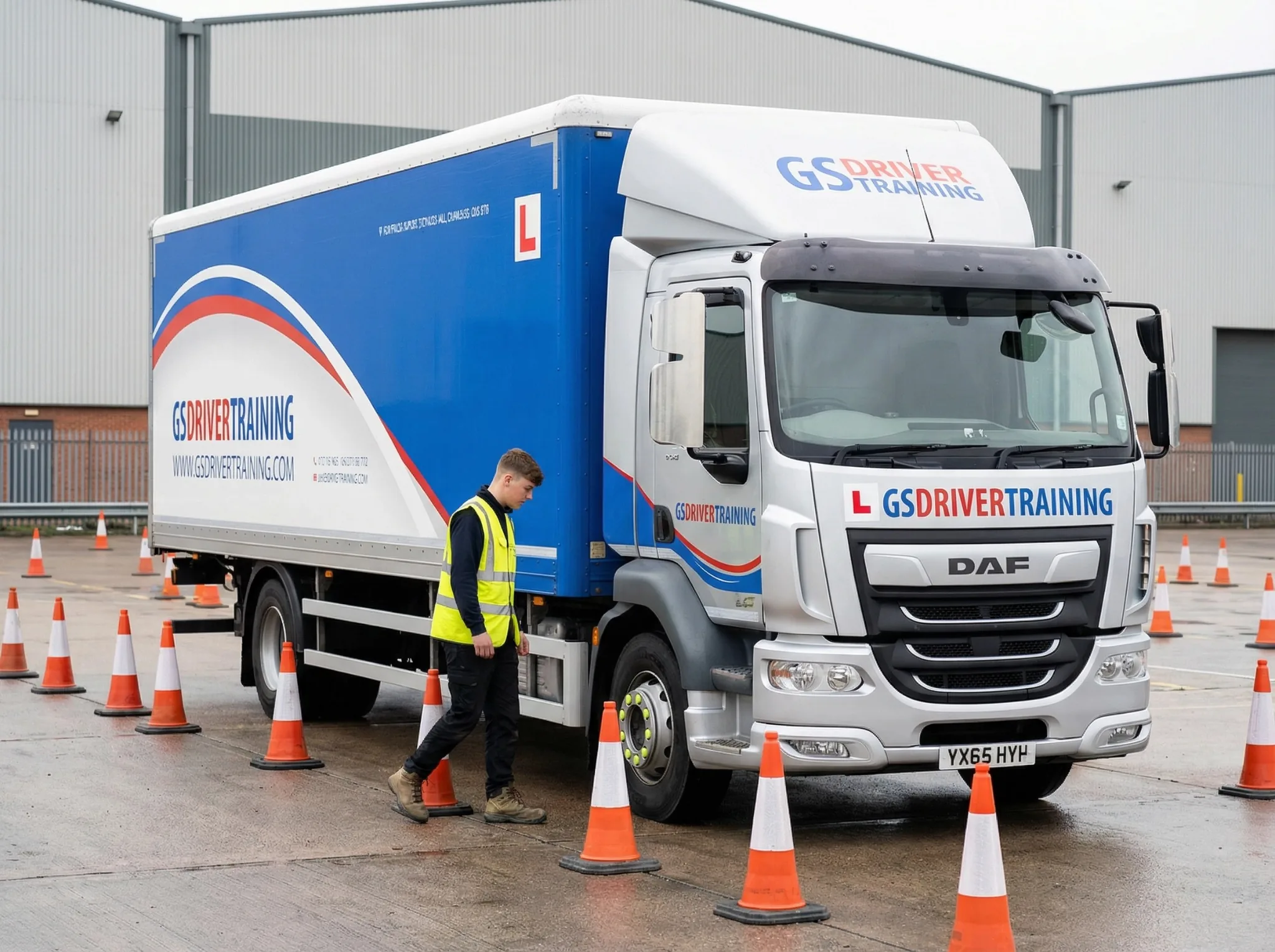
What Is an HGV Licence?
An HGV licence (Heavy Goods Vehicle licence) is a driving qualification that allows you to legally operate large goods vehicles on UK roads. It is an addition to your standard car driving licence (Category B) and is required for any vehicle over 3,500 kg gross vehicle weight.
The terms "HGV licence" and "LGV licence" (Large Goods Vehicle) are used interchangeably — they refer to exactly the same qualification. "HGV" is the traditional British term that most people use, while "LGV" is the official EU/legal term on your driving licence. When you search for "HGV licence" or "LGV licence," you are looking for the same thing.
HGV licences are divided into several categories (C1, C1+E, C, and C+E), each allowing you to drive progressively larger vehicles. The category you need depends on the type and size of vehicle you want to drive, and whether you need to tow a trailer.
HGV Licence Categories Explained
Understanding which licence category you need is the first step. Here is a breakdown of every HGV licence category available in the UK.
Category C1
Vehicles: 3,500 kg – 7,500 kg
Medium vehicles including large vans, small lorries, and ambulances. Essential for ambulance and paramedic roles.
Category C1+E
Vehicles: C1 vehicle + trailer over 750 kg (max 12,000 kg)
Extends C1 to include larger trailers. Popular for horse transport and recovery vehicles.
Category C (Class 2)
Vehicles: Over 3,500 kg, trailer up to 750 kg
Drive rigid vehicles of any weight — the classic 'Class 2' HGV licence. Most common starting point for HGV careers.
Category C+E (Class 1)
Vehicles: Cat C vehicle + trailer over 750 kg
The highest HGV licence — drive articulated lorries with no weight restriction. Unlocks the highest-paying jobs.
Requirements & Eligibility
Before you can start HGV training, you need to meet several basic requirements set by the DVLA and DVSA. The good news is that most people with a standard car licence already meet the core criteria.
Full UK Car Licence
You must hold a valid Category B (car) driving licence. Provisional licences are not sufficient.
Minimum Age
18 years old with Driver CPC, or 21 without. Some categories have specific age requirements.
Medical Fitness
Pass a D4 medical examination confirming you meet the higher medical standards for HGV driving.
Provisional HGV Licence
Apply to the DVLA for a provisional entitlement for the HGV category you want to drive.
Theory Test Pass
Pass the HGV theory test (multiple choice + hazard perception) before your practical test.
No Experience Required
You do not need any prior experience with large vehicles. Our instructors train complete beginners.
The D4 Medical Examination
The D4 medical is a mandatory health assessment required before you can apply for a provisional HGV licence. It is more thorough than a standard driving medical because HGV drivers operate larger, heavier vehicles that pose greater risks on the road.
The examination is conducted by a registered doctor (it does not have to be your own GP) and typically costs £75-£150. It covers eyesight (including visual acuity and field of vision), blood pressure and cardiovascular health, diabetes screening, neurological conditions, hearing, and general physical fitness. The doctor completes the D4 form, which you then submit to the DVLA with your provisional licence application.
The medical is valid for 5 years if you are under 45, 5 years between ages 45-65, and annually after age 65. We can help arrange your D4 medical at a convenient location — visit our HGV Medical page for more details and to book.
The HGV Theory Test
The HGV theory test consists of two parts that must both be passed in the same sitting. It is taken at a DVSA theory test centre and costs £26 for the multiple choice section plus £23 for hazard perception (£49 total).
Part 1: Multiple Choice
- 100 questions from a bank of over 1,000
- Pass mark: 85 out of 100 (85%)
- Time allowed: 115 minutes
- Topics: road safety, vehicle loading, regulations, hazard awareness
Part 2: Hazard Perception
- 19 video clips showing real driving scenarios
- Pass mark: 67 out of 100
- Click when you spot a developing hazard
- Earlier response = higher score
Your theory test certificate is valid for 2 years — you must pass your practical test within this period. We provide comprehensive study materials and access to mock tests as part of our training packages. Visit our Theory Training page for preparation resources.
The HGV Practical Driving Test
The HGV practical test is conducted by a DVSA examiner and lasts approximately 90 minutes. It is more comprehensive than the car driving test and consists of several distinct sections:
Vehicle Safety Questions: The examiner will ask you to demonstrate checks on the vehicle, such as checking tyre pressure, oil levels, brake fluid, and lights. You will be asked "show me" and "tell me" questions about vehicle safety.
Reversing Exercise: You will need to demonstrate controlled reversing into a designated area. This tests your ability to manoeuvre a large vehicle safely and accurately using mirrors and spatial awareness.
On-Road Driving: The main portion of the test involves driving on public roads in various conditions including urban areas, dual carriageways, and rural roads. The examiner assesses your observation, positioning, speed management, and overall vehicle control.
At GS Driver Training, we prepare you thoroughly for every element of the practical test. Our DVSA-approved instructors know exactly what examiners look for and will ensure you are confident and test-ready before your examination date.
HGV Licence Costs — Full Breakdown
Here is a transparent breakdown of every cost involved in getting your HGV licence, so there are no surprises.
| Item | Cost |
|---|---|
| D4 Medical Examination | £75 – £150 |
| Provisional HGV Licence (DVLA) | £43 |
| Theory Test (Multiple Choice) | £26 |
| Theory Test (Hazard Perception) | £23 |
| Class 2 (Cat C) Training | From £1,691 |
| Class 1 (Cat C+E) Training | From £1,691 |
| Fast Track C+E Training | From £3,200 |
| C1 Training | From £875 |
| Driver CPC (per module) | From £65 |
For a Class 2 licence, the total investment is approximately £1,850-£1,950. For a Class 1 licence (if you already hold Class 2), it is similar. The Fast Track route from car licence to Class 1 costs approximately £3,350-£3,500 all-in. We offer finance agreements to help spread the cost over manageable monthly payments.
Driver CPC Explained
The Driver Certificate of Professional Competence (CPC) is a legal requirement for anyone who drives an HGV or PCV professionally — meaning "for hire or reward." If you drive a lorry as part of your job (whether employed or self-employed), you need a valid Driver CPC in addition to your HGV licence.
The initial Driver CPC consists of two additional tests beyond the standard HGV licence: Module 2 (case studies) and Module 4 (practical demonstration). Once qualified, you must complete 35 hours of periodic training every 5 years to maintain your Driver Qualification Card (DQC). This training can be spread across the 5-year period — for example, one 7-hour course per year.
At GS Driver Training, we offer both initial and periodic CPC courses. Our JAUPT-approved courses cover topics including safe loading, fuel-efficient driving, driver health, and legal compliance. Certificates are issued on the same day. Visit our Driver CPC Training page for dates and booking.
Renewing Your HGV Licence
Your HGV licence must be renewed periodically to confirm your continued medical fitness to drive. The renewal schedule depends on your age:
- Under 45: Renew every 5 years
- Ages 45-65: Renew every 5 years
- Over 65: Renew annually
Renewal requires a new D4 medical examination and submitting form D2 to the DVLA with the fee of £43. There is no requirement to retake your theory or practical test — you simply need to demonstrate continued medical fitness. We recommend starting the renewal process 2-3 months before your licence expires to avoid any gap in validity.
If your HGV licence has lapsed for more than 5 years, you may need to retake the theory and practical tests. Contact the DVLA or speak to us for guidance on your specific situation.
Frequently Asked Questions
Common questions about getting and maintaining your HGV licence.
How do I get an HGV licence in the UK?
How much does an HGV licence cost?
How long does it take to get an HGV licence?
Can I get an HGV licence at 18?
What medical conditions prevent you from getting an HGV licence?
What is the difference between HGV Class 1 and Class 2?
Do I need a CPC to drive an HGV?
How do I renew my HGV licence?
Related Resources
HGV Training Courses
View all courses with prices
Theory Training
Prepare for your theory test
HGV Medical
D4 medical examination info
Finance Options
Spread the cost of training
Training Locations
Find training near you
Student Reviews
What our students say
New Career Guide
Start your HGV career
Contact Us
Get in touch or book