
How to Become an HGV Driver in the UK
Becoming an HGV (Heavy Goods Vehicle) driver is one of the most accessible and rewarding career paths available in the UK. You do not need a degree, and with the right training, you can be earning £30,000–£50,000+ within your first year. This guide walks you through every step of the process, from initial requirements to landing your first job.
Step 1: Check You Meet the Basic Requirements
Before you begin, make sure you meet these minimum requirements:
- Age: You must be at least 18 to drive a lorry (Category C) or 21 for some passenger-carrying vehicles.
- Driving licence: You need a full UK car driving licence (Category B).
- Health: You must be medically fit to drive large vehicles (assessed via the D4 medical).
- Right to work: You must have the legal right to work in the UK.
There are no educational qualifications required. Whether you have left school at 16 or have a university degree, the path to becoming an HGV driver is the same.
Step 2: Get Your HGV Medical (D4 Form)
The HGV medical is a comprehensive health check carried out by a doctor. It covers your eyesight, blood pressure, heart health, diabetes status, and general fitness. The D4 medical form is then sent to the DVLA as part of your provisional HGV licence application.
The medical typically costs £50–£100 and can be done at your GP surgery or a specialist occupational health clinic. At GS Driver Training, we can recommend local providers and help you through the process.
Step 3: Apply for Your Provisional HGV Entitlement
Once you have your D4 medical completed, send it to the DVLA along with a D2 application form. This adds the provisional HGV entitlement to your driving licence. Processing typically takes 2–4 weeks, so apply early.
There is no fee for adding the provisional entitlement, but you will need to include a passport-sized photo and your current driving licence.
Step 4: Pass the HGV Theory Test
The HGV theory test consists of two parts:
- Multiple choice: 100 questions (you need 85 correct to pass). Topics include road safety, vehicle operation, and the Highway Code.
- Hazard perception: 19 video clips where you identify developing hazards. You need 67 out of 100 to pass.
The theory test costs £26 and can be booked through the DVSA. We recommend using official DVSA practice materials and apps to prepare. Most students need 2–4 weeks of study.
Step 5: Complete Your Practical Training
This is where the real learning happens. Practical training involves learning to drive a large vehicle safely, including:
- Vehicle checks and safety procedures
- Moving off, stopping, and gear control (or automatic transmission operation)
- Reversing exercises (Module 3a)
- Road driving on various road types
- Coupling and uncoupling (for C+E/Class 1)
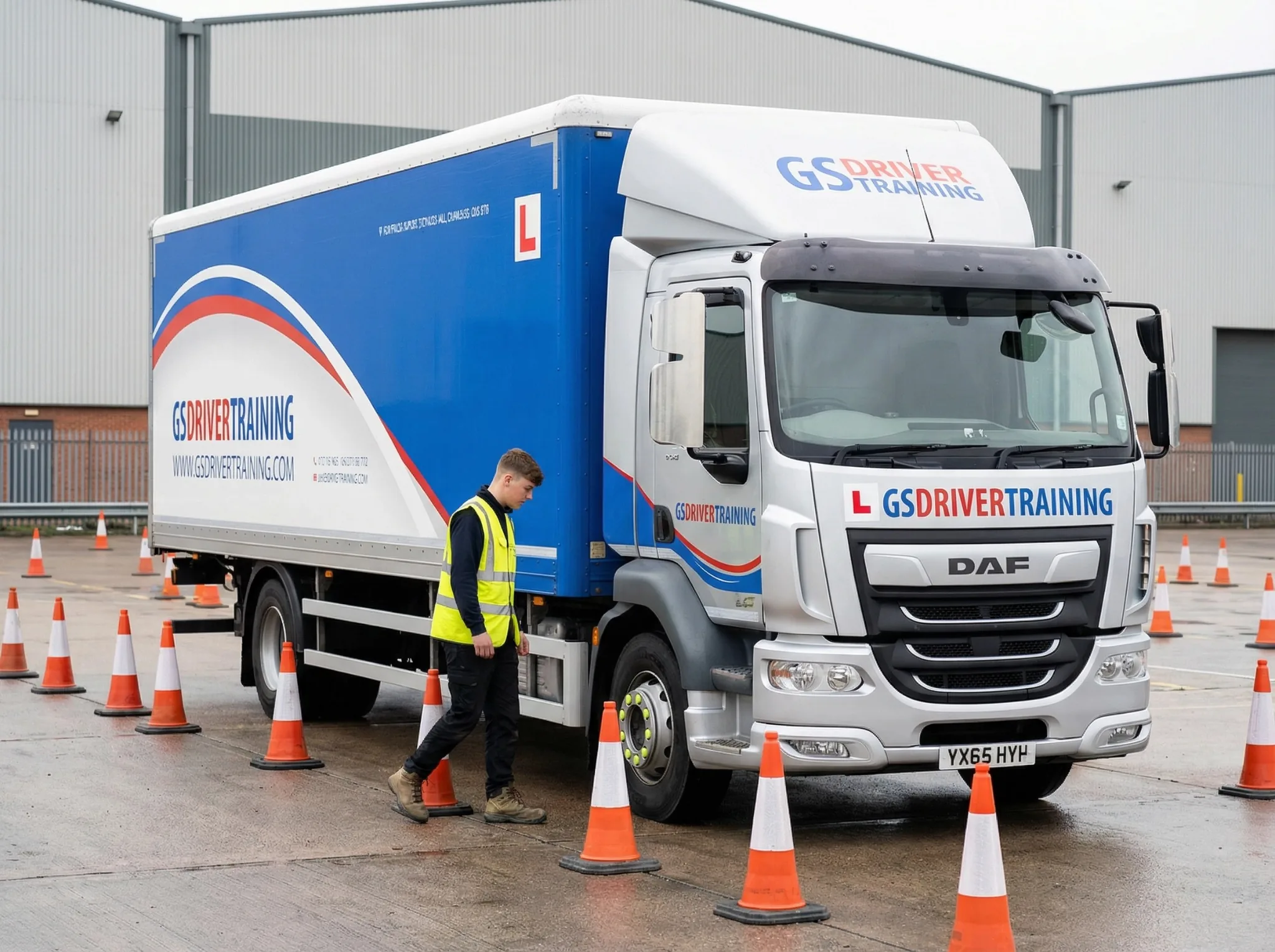
At GS Driver Training, we train on modern, fully automatic DAF trucks at our dedicated facility at Dunsfold Aerodrome. Our intensive courses typically run for 3–5 days, depending on the licence category.
Step 6: Pass the Practical Driving Test
The DVSA practical test includes:
- Vehicle safety questions: “Show me, tell me” questions about vehicle checks.
- Reversing exercise (Module 3a): Demonstrating controlled reversing into a bay or around a corner.
- On-road driving (Module 3b): Approximately 60 minutes of driving on various road types, assessed on your ability to drive safely and competently.
Our students take their tests at the Guildford DVSA test centre. We provide full test preparation, including practice on the actual test routes.
Step 7: Complete Your Driver CPC
To drive professionally (for hire or reward), you need to complete the initial Driver CPC. This consists of four modules:
- Module 1: Theory test (multiple choice) — completed as part of Step 4
- Module 2: Theory test (case studies) — completed as part of Step 4
- Module 3: Practical driving test — completed as part of Step 6
- Module 4: Practical demonstration test — a separate assessment covering vehicle safety and load security
We conduct Module 4 assessments in-house at our training centre, making it quick and convenient to complete your CPC qualification.
Step 8: Find Your First HGV Driving Job
With your licence and CPC in hand, you are ready to start working. Here are the main routes into employment:
- Agency work: A popular starting point. Agencies like Manpower, Pertemps, and Driver Hire can place you quickly, often within days of qualifying.
- Direct employment: Apply directly to logistics companies, supermarket chains, construction firms, or local haulage operators.
- Job boards: Sites like Indeed, Reed, and specialist platforms like HGV Jobs carry thousands of driver vacancies.
Many of our graduates secure employment within 2–4 weeks of qualifying. The current driver shortage means employers are actively seeking new drivers.
How Much Does It All Cost?
| Item | Typical Cost |
|---|---|
| D4 Medical | £50 – £100 |
| Theory Test | £26 |
| Practical Training + Test (Cat C) | From £847 inc VAT |
| CPC Module 4 | Included in our packages |
We offer flexible finance options from £30/month, making it possible to start training without the full amount upfront.
Ready to become an HGV driver? Call GS Driver Training on 01252 447808 or browse our courses to find the right package for you.